
LuckyWins Games: Slots, Tables and Live Casino
 Available in AU

LuckyWins has a broad multi-studio casino lobby, with slots and jackpots alongside blackjack, roulette and streamed dealer games. Each category carries different rules and session risks, and the number of titles alone does not describe the mathematics of any game.
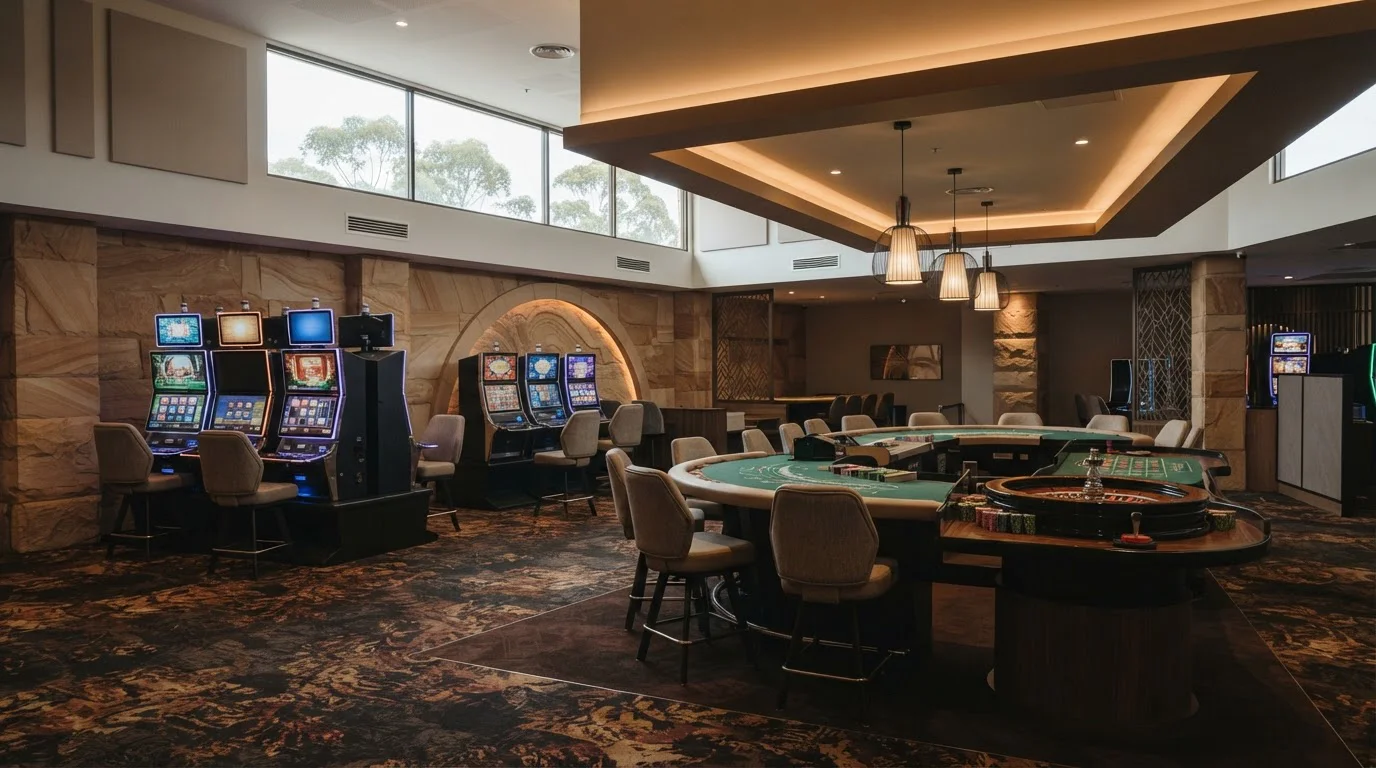
Table of Contents
Provider availability and regional game filters
LuckyWins operates a lobby drawing together different kinds of casino software. A provider’s presence in a catalogue does not mean every title is licensed for every location or exposed to every account. Game suppliers may apply geographical exclusions independently of a casino’s own interface. A platform can show categories that are wider than the collection available to one particular customer.
LuckyWins’ terms include geographical restrictions relevant to named providers. NetEnt lists Australia among its excluded territories, and Amatic titles also carry Australian restrictions. Those provisions describe supplier-level access rules, not a way of making the service available to Australian residents. They also demonstrate why a headline game total is a poor substitute for an examination of an actual lobby’s eligible content.
The distinction becomes important where a title has several branded versions. Two games with closely related names may be distributed by different studios, carry different mathematical models or appear only in a particular product segment. A provider catalogue, a casino listing and a player’s actual game-selection screen represent three separate layers. A total assembled at one layer need not match another.
Licensing, game availability and how a title behaves are distinct questions. The regional legal position of the casino is addressed in the licensing section. Within the game catalogue, the practical reading is that software-provider terms can narrow what appears in a particular territory or account. Nothing about the presence of an English-language interface or an AUD currency option alters those terms.
- Studio rules: suppliers can exclude jurisdictions or specific distribution channels.
- Game variants: different versions may use distinct stake ranges, bonus mechanics or theoretical returns.
- Device compatibility: a title may display differently in a mobile browser than on a desktop screen.
- Session settings: an account’s safety limits apply alongside the rules of the game itself.
Provider filters can also affect which jackpots, table variations or live sessions are visible. An image of a broad lobby would not resolve those differences. Looking at game types individually provides a more meaningful understanding of the casino’s structure than treating every icon as an interchangeable product.
The scale and organisation of the LuckyWins lobby
LuckyWins groups slots, jackpots, blackjack, roulette, live-dealer tables and game-show formats in its catalogue. These categories differ in how rounds unfold, how stakes are placed and how outcomes are determined. A title can be added, retired or restricted without changing the name of its category. The useful starting point is therefore the type of game and its rules, rather than a fixed catalogue total.
A studio produces games, while a casino brings titles from different suppliers into a single interface. An aggregator can distribute games from several studios, and a studio may offer several versions of one title. These relationships explain why the number of suppliers and the number of games measure different things. Neither number describes the rules of the particular version a player sees.
A large list still requires navigation. Slots tend to be organised by feature, theme or provider. Table games may be grouped by rules such as blackjack or roulette, while live content often has a separate area because sessions are tied to streams or hosted tables. Those categories organise very different experiences and do not imply equivalent expected outcomes.
| Game family | Typical decision | Main risk variable |
|---|---|---|
| Slots | Choose a title, denomination and game pace | Volatility and the title-specific return model |
| Jackpot games | Read jackpot eligibility and prize conditions | Low-frequency large outcomes and exposure over time |
| Blackjack | Understand rules for dealer actions and payouts | Rule variation and decisions made during each hand |
| Roulette | Identify wheel type and bet coverage | Wheel rules, probability and stake concentration |
| Live tables and game shows | Follow streamed rounds and session rhythm | Session speed, feature rules and repeated stakes |
RTP is specific to a game and its settings; it is not a single measure for the entire casino. Each game may have its own paytable, odds and rules. The casino-wide catalogue count is not a shortcut for a title’s mathematical characteristics. The number of available games tells the reader about breadth, while the game’s own information determines what a particular stake represents.
Browsing also has a time cost. A lobby that places many visually similar titles together can encourage quick switching, which may make accumulated stakes harder to notice. Treating the number of rounds and total money staked as separate measures makes session exposure easier to understand. Account limits and cooling-off controls are relevant to that behavioural side of gameplay.
Slots, jackpots and traditional table rules
Slots combine a chosen stake with a programmed set of possible outcomes. Themes, animations and advertised features can make titles feel different, but the financial behaviour depends on the specific game’s mathematical design. Return to player (RTP) is a theoretical long-run measure calculated over a very large sequence of play; it does not guarantee that an individual session will return that percentage.
Volatility describes the distribution of outcomes, not an extra fee. A more volatile title can produce extended runs without meaningful returns while reserving more value for infrequent larger events. Lower volatility does not make a game profitable; it changes how wins and losses are distributed. A game’s stated RTP and house edge apply to that version and its rules, rather than to the casino brand as a whole.
Jackpot features introduce another condition: eligibility. A progressive prize may grow over time, but its size does not state the chance of winning it or the stake requirement needed to qualify. A headline prize amount cannot be understood independently of the associated game rules and trigger conditions.
Blackjack and roulette use recognisable labels but have meaningful rule differences. In blackjack, deck count, dealer actions, payout rules and permitted moves influence the underlying probabilities. Roulette variants differ in wheel layout and bet types. A label on the game tile is therefore a starting point rather than a complete description of the proposition.
- Separate the name of the category from the rules of an individual title.
- Identify the stake definition: per line, per spin, per hand or per round.
- Read the displayed game rules and any paytable before interpreting a prize illustration.
- Recognise that the theoretical return relates to many rounds and does not predict the outcome of the next one.
- Account for the cumulative stake across a session rather than only the denomination shown on the screen.
For example, forty rounds at €2 each represent €80 in total stakes, although the account balance may change after every round. This is a hypothetical calculation of turnover, not an expected loss estimate and not a recommendation to play. The relationship between repeated stakes and an account’s funding balance matters more than any single animation on a game screen.
Game rules and payment mechanics also intersect. Staked currency, account currency and the deposit route are separate concepts; using a crypto-funded account does not change a slot’s rules. The payment overview explains how fiat denominations and crypto transfers fit into the broader account system.
Live casino tables and game-show pacing
Live-dealer games replace an exclusively graphical round with a streamed session, commonly hosted by a human dealer or presenter. LuckyWins includes live-dealer and game-show categories alongside conventional casino tables. The stream changes the presentation and rhythm of play, but it does not remove the underlying uncertainty or the house advantage built into the rules.
At a live blackjack table, players can face decisions within a short window before a dealer advances the hand. Live roulette uses a wheel event with an observable result, while game-show formats can add staged features or variable multipliers. The probability model is defined by that particular product. A dramatic reveal or a longer animated sequence does not make an outcome more predictable.
Session pace is central. Automated slots may allow repeated rounds with limited pauses, while streamed tables involve waiting for a dealer, a scheduled outcome or other participants. Neither format imposes a reliable ceiling on money staked. A slower round might encourage larger individual stakes; a faster one might generate a higher number of small stakes. The total exposure is the combination of both factors.
Latency and device quality also matter to comprehension. In a mobile browser, a small screen may show the table alongside timers, chat, history and wagering controls. When a connection is interrupted, the result of a completed round may still be governed by the game server. Interface presentation should not be confused with the underlying transaction record or with eligibility for a settlement.
- Live blackjack: read the payout and dealer rules for the exact table.
- Live roulette: note the wheel and bet definitions rather than assuming all versions use the same distribution.
- Game shows: distinguish on-screen multipliers from the frequency with which each outcome occurs.
- Every live format: consider the pace of consecutive stakes and the account’s spending limits.
There is also a social difference. Dealer commentary, chat and recurring rounds may extend the time spent in a session. Entertainment value is a separate issue from financial return. A timer, a set spending boundary or a cooling-off period is a more reliable constraint on overall exposure than assuming that a streamed event will naturally end the session.
LuckyWins combines these streamed experiences with a large selection of machine-based games. The categories explain the shape of its product; they do not establish a favourable chance of winning. The distinction is especially important when comparing polished live presentation with the same underlying financial risk faced in any casino format.
Questions about LuckyWins games
Which game categories does LuckyWins feature?
LuckyWins groups slots, jackpots, blackjack, roulette, live-dealer tables and game-show formats in its wider casino catalogue.
Can different versions of a game have different rules?
Yes. Versions of a game can differ in their paytables, stake ranges and return settings. The rules for the selected version determine how its bets and payouts work.
Does the listed catalogue apply identically in every country?
No. Software suppliers can apply territory-specific restrictions, so a general lobby count does not imply identical access to every title.
Does a slot RTP describe the result of one session?
No. RTP is a theoretical long-run percentage for a particular game, not a prediction of any individual session or spin.
Are live-dealer games risk-free because outcomes are streamed?
No. A streamed dealer or wheel changes the presentation, not the financial risk associated with repeated stakes.
Can account limits apply to different game categories?
Yes. Loss and wagering limits concern account activity across game categories. LuckyWins also describes deposit limits, cooling-off and self-exclusion; its policy notes exceptions for cryptocurrency deposits.
Game variety is separate from game economics
LuckyWins brings together a broad selection of slots, table games, jackpots and streamed live content. The categories reveal the different rules and rhythms behind individual titles. A provider restriction may narrow the actual selection, and a large library says nothing on its own about likely financial returns.
The useful comparison is between specific game rules, session pace and cumulative exposure. Neither a colourful lobby nor a streamed table changes the basic possibility of losing the money staked. The account’s available spending controls are relevant across all of these formats.